


 English
 中文简体
中文简体 عربى
عربى
NEWS
Search by posts
Calendar
Industry News
 By Admin
What Is Mineral Fiber? Types, Properties & Recycle Cotton
Content
- 1 What Is Mineral Fiber? A Direct Answer
- 2 The Main Types of Mineral Fiber and Their Differences
- 3 How Mineral Fiber Is Made: The Manufacturing Process
- 4 Key Properties That Define Mineral Fiber Performance
- 5 Mineral Fiber vs. Recycle Cotton: Understanding Where Each Material Fits
- 6 Recycled Content in Mineral Fiber Production
- 7 Health and Safety Considerations Around Mineral Fiber
- 8 Major Application Areas for Mineral Fiber
- 9 Sustainability Challenges and End-of-Life Issues
- 10 Regulatory Environment and Industry Standards
- 11 Emerging Trends: Bio-Based Binders and Next-Generation Mineral Fiber
- 12 Choosing Between Mineral Fiber and Recycle Cotton: A Practical Framework
What Is Mineral Fiber? A Direct Answer
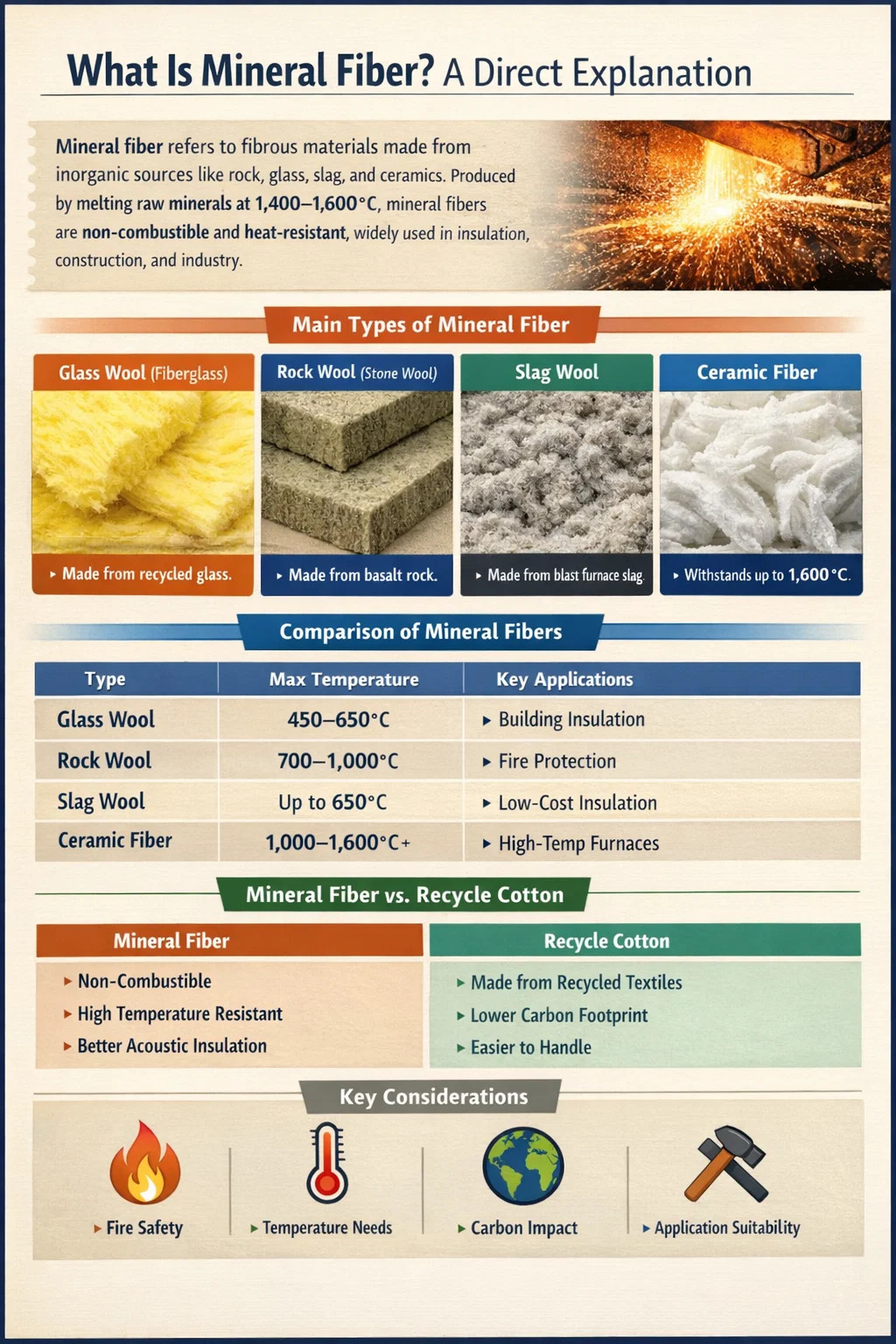
Mineral fiber refers to a broad category of fibrous materials derived from inorganic sources — primarily rock, glass, slag, and ceramic compounds. These fibers are produced by melting raw mineral materials at extremely high temperatures (typically between 1,400°C and 1,600°C) and then drawing or spinning the molten mass into thin filaments. The result is a lightweight, heat-resistant, chemically stable material used across insulation, construction, automotive, and filtration industries.
The most widely known types include fiberglass (glass wool), rock wool (stone wool), slag wool, and ceramic fiber. Each type differs in its raw material base, temperature tolerance, and application range, but all share the defining characteristic of being non-combustible and resistant to thermal degradation — properties that make them fundamentally different from organic fibers like cotton or polyester.
Understanding mineral fiber is particularly relevant today in the context of sustainable manufacturing. As industries seek to reduce synthetic material consumption and carbon footprints, questions arise about how mineral fiber compares to alternatives like recycle cotton and other recovered textile fibers. This article explores what mineral fiber is, how it performs, and where it fits in the larger picture of recycled and sustainable materials.
The Main Types of Mineral Fiber and Their Differences
Not all mineral fibers are the same. The category encompasses several distinct materials, each with its own production method, physical properties, and end-use profile. Understanding the differences is important for anyone specifying materials in construction, industrial, or consumer product applications.
Glass Wool (Fiberglass)
Glass wool is manufactured from silica sand, recycled glass cullet, and other mineral oxides melted together. The molten glass is spun into fine fibers using a centrifuge or blowing process, producing a fluffy, tangled matrix ideal for thermal and acoustic insulation. Glass wool typically handles temperatures up to around 450°C to 650°C, depending on the product grade. Global production exceeds 5 million tonnes per year, making it the most produced form of mineral fiber worldwide. A significant portion of its raw input — sometimes 60–80% — consists of post-consumer recycled glass, giving it partial circular-economy credentials even before considering recycle cotton analogies.
Rock Wool (Stone Wool)
Rock wool is made from volcanic rock (basalt) and/or diabase. It is melted in a cupola furnace with coke as fuel and spun at high speed. Because of its denser structure and mineral composition, rock wool tolerates higher temperatures than glass wool — typically up to 700°C to 1,000°C for standard grades. It is the preferred choice for fire-rated building assemblies, pipe insulation, and industrial process equipment. Rock wool also provides superior sound absorption, with noise reduction coefficients (NRC) often ranging from 0.90 to 1.05.
Slag Wool
Slag wool is produced from the molten waste slag generated in steel and iron blast furnace operations — a material that would otherwise require disposal. Because it uses an industrial by-product as its primary raw material, slag wool has a notably lower embodied energy footprint than virgin-mineral products. Its temperature resistance is somewhat lower than rock wool, generally up to 650°C, but it offers strong value in lower-temperature insulation applications and is common in parts of Eastern Europe, China, and North America.
Ceramic Fiber and Refractory Ceramic Fiber (RCF)
Ceramic fiber is an engineered, high-purity product made from alumina (Al₂O₃) and silica (SiO₂), often with additions of zirconia or other oxides for extreme-temperature stability. Unlike insulation-grade mineral fibers, ceramic fiber is designed to function continuously at temperatures from 1,000°C up to 1,600°C or more. It is used in furnace linings, kiln furniture, aerospace components, and catalytic converter substrates. Because of its greater heat stability and purity, it is significantly more expensive than glass or rock wool.
| Type | Primary Raw Material | Max Temperature | Key Applications |
|---|---|---|---|
| Glass wool | Silica sand, recycled glass | 450–650°C | Building insulation, HVAC |
| Rock wool | Basalt, diabase | 700–1,000°C | Fire protection, acoustics, pipes |
| Slag wool | Blast furnace slag | Up to 650°C | General insulation, low-cost applications |
| Ceramic fiber | Alumina, silica | 1,000–1,600°C+ | Kilns, furnaces, aerospace |
How Mineral Fiber Is Made: The Manufacturing Process
The production of mineral fiber, regardless of type, follows a general sequence: raw material preparation, high-temperature melting, fiber formation, and finishing. Each stage influences the final product's density, fiber diameter, and performance characteristics.
For glass wool, raw materials are fed into a gas-fired melting furnace, where temperatures reach roughly 1,450°C. The molten glass flows through a spinning head — a rapidly rotating perforated disk — and centrifugal force throws the glass outward through small holes, stretching it into thin fibers. Air jets break and attenuate the fibers further. A binder (usually a phenol-formaldehyde or formaldehyde-free resin) is sprayed onto the fibers, which then fall onto a conveyor in a loosely packed mat, pass through a curing oven at around 200°C, and emerge as the familiar yellow or light-pink insulation batts.
Rock wool uses a different method. Raw basalt and coke are charged into a cupola furnace. Combustion of coke melts the rock, and the liquid stream falls onto a high-speed rotor cascade — a series of spinning wheels — that spins the melt into fibers by flinging it radially. A binder is applied, and the resulting fiber cloud is collected on a moving belt, compressed to the target density, and cured.
Fiber diameter has a direct impact on both performance and health risk. Fine glass wool fibers used in insulation typically have diameters between 3 and 10 micrometers. Fibers below about 3.5 micrometers in diameter and longer than 5 micrometers are considered biopersistent — they can lodge in lung tissue. Modern man-made vitreous fibers (MMVF) used in building products are generally engineered to dissolve in lung fluid within 40 days, a criterion codified in European regulation (Nota Q of REACH Annex VI). This is one significant health-regulatory distinction between industrial-grade mineral fiber and the older, more hazardous asbestos, which is persistent in tissue.
Key Properties That Define Mineral Fiber Performance
Mineral fiber is valued across so many industries because its material properties solve problems that organic fibers and polymers cannot. The core performance attributes include the following.
Thermal Resistance and Insulation Value
The thermal conductivity (λ) of glass wool insulation at 25°C typically ranges from 0.030 to 0.040 W/(m·K), making it one of the most effective bulk insulation materials available at its price point. Rock wool products are similar — approximately 0.033 to 0.040 W/(m·K) — but maintain that performance at higher temperatures where glass wool would begin to soften or fail. For comparison, a standard expanded polystyrene (EPS) foam board has a λ value around 0.035–0.038 W/(m·K), placing it in a similar range but without the fire-resistance profile of mineral fiber.
Non-Combustibility
One of the most decisive properties of mineral fiber is its non-combustibility. Rock wool and glass wool are classified as A1 or A2 under European standard EN 13501-1, meaning they contribute no fuel load to a fire. This is why mineral fiber boards are used in fire-rated wall and floor assemblies, and why they are specified in buildings over a certain height in many jurisdictions. In fire scenarios, they also do not emit toxic gases in the quantities that burning polymers do, which is critically relevant for building safety regulations following major fires in several countries over the past decade.
Acoustic Absorption
The random, tangled fiber structure of mineral wool makes it an excellent porous absorber of airborne sound. Energy from sound waves is converted into heat via viscous friction as air molecules are forced through the fiber matrix. Rock wool ceiling tiles and wall panels are routinely specified to achieve NRC values of 0.80 to 1.05, with 1.0 meaning essentially complete sound absorption. Glass wool performs similarly for mid-to-high frequencies, though somewhat less effectively at low frequencies without additional mass.
Moisture and Chemical Resistance
Mineral fibers themselves do not absorb water and do not rot, mold, or biodegrade under normal conditions. However, the binder resins used in most mineral fiber products can be affected by prolonged moisture exposure, which can compromise structural integrity in boards. Rock wool is generally more hydrophobic than glass wool when properly produced with oil treatment, retaining its structure even when subjected to simulated driving rain tests in building façade applications.
Dimensional Stability
Unlike many polymeric insulation materials that can creep or compress over time under mechanical load, high-density rock wool maintains its thickness and thermal performance over decades. This is particularly relevant in flat roof applications, where insulation boards bear foot traffic and roof system loads. Mineral fiber boards of 150–200 kg/m³ are routinely used in green roof and inverted roof assemblies where long-term dimensional stability is required.
Mineral Fiber vs. Recycle Cotton: Understanding Where Each Material Fits
Recycle cotton — also called recycled cotton fiber or shoddy — is produced by mechanically shredding post-consumer or post-industrial cotton textiles back into a fiber state. The recovered fiber can then be re-spun into yarn, needled into nonwoven batting, or blended with virgin cotton or synthetic fibers. The recycle cotton industry processes an estimated 15–20% of the roughly 92 million tonnes of textile waste generated globally each year, though actual diversion rates vary considerably by region.
At first glance, mineral fiber and recycle cotton seem to serve entirely different markets. Mineral fiber is inorganic, non-combustible, and typically engineered for thermal and acoustic performance in construction and industrial settings. Recycle cotton is organic, biodegradable, and commonly associated with apparel, home textiles, and automotive interior applications. But the two categories do overlap — specifically in nonwoven insulation products used in automotive panels, building underlayment, and HVAC duct liners.
Applications Where Recycle Cotton Competes with Mineral Fiber
In automotive manufacturing, both mineral fiber (typically glass fiber mat or needle-punched rock wool) and recycle cotton nonwovens are used for under-hood insulation, trunk liners, door panels, and headliners. Automotive OEMs in Europe and North America have increasingly turned to recycle cotton-based materials as part of vehicle sustainability targets — for example, Ford Motor Company has historically incorporated recycled cotton fiber in its vehicle interiors. The appeal is twofold: the material diverts textile waste from landfill, and it carries lower production energy per kilogram than manufacturing new glass fiber.
However, recycle cotton is not a universal substitute for mineral fiber. Its temperature limit — generally below 200°C without flame retardant treatment — means it cannot perform in locations adjacent to exhaust systems or engine heat shields, where mineral fiber and ceramic fiber remain essential. Recycle cotton also absorbs moisture more readily than mineral fiber, which matters in environments subject to condensation or humidity cycling.
In building applications, recycle cotton denim insulation batts have gained traction in residential construction, particularly in North America, where products made from post-consumer denim jeans are sold as an alternative to fiberglass batts. These products achieve thermal conductivity values of approximately 0.039–0.042 W/(m·K) — competitive with standard glass wool — and are marketed on the basis of improved handling safety (no skin irritation from fibers) and reduced embodied carbon. However, they require flame retardant additives (typically borate-based) to meet building code requirements, and they have higher susceptibility to moisture damage than mineral fiber.
Carbon Footprint Comparison
Life cycle assessment (LCA) data for mineral fiber manufacturing shows global warming potential (GWP) values typically ranging from 1.5 to 3.0 kg CO₂-equivalent per kg of product for glass wool, and 1.2 to 2.0 kg CO₂-eq/kg for rock wool, depending on energy source and recycled content inputs. Recycle cotton fiber, because it avoids the highly energy-intensive cotton growing and initial textile processing stages, can achieve GWP values below 1.0 kg CO₂-eq/kg, particularly when processed with renewable energy. This gives recycled cotton-based insulation a meaningful carbon advantage on a per-kilogram basis — though the comparison requires careful system boundary definition, since the thermal performance per unit thickness and the service life assumptions differ.
Recycled Content in Mineral Fiber Production
A point frequently overlooked in discussions about mineral fiber sustainability is that the industry already incorporates substantial recycled content — and has done so for decades. This makes mineral fiber itself a participant in circular material flows, albeit through a different recycling stream than textile-based recycle cotton.
Glass wool manufacturers typically use 60 to 80% cullet (recycled glass from bottles, jars, and flat glass waste) as raw material input. Leading producers like Isover (Saint-Gobain), Knauf Insulation, and Owens Corning have published corporate sustainability targets to increase recycled glass content further, with some plants approaching 85% recycled input in their total raw material charge.
Rock wool production has a lower proportion of pre-consumer recycled content in the mineral charge itself (since basalt is a primary raw material), but the industry has made progress on incorporating production waste. Knauf Insulation, for example, reports a production waste recovery rate above 99% at many facilities — meaning fiber offcuts and trim waste are remelted and reprocessed rather than landfilled. Some manufacturers also accept post-consumer rock wool from building demolition sites for recycling, though collection logistics remain a barrier at scale.
Compared to recycle cotton processes — which mechanically shred and re-fiber existing textiles — mineral fiber recycling involves melting, which consumes energy but fully resets the material to a homogenous raw state, capable of being remanufactured to the same specifications as virgin-input product. This is a meaningful distinction in material quality terms: recycle cotton fiber is shorter, weaker, and less uniform than virgin cotton fiber after mechanical shredding, whereas recycled glass cullet in glass wool produces a product indistinguishable from one made with virgin sand.
Health and Safety Considerations Around Mineral Fiber
The health and safety profile of mineral fiber has been a subject of scientific and regulatory scrutiny for decades, driven in part by the historical association between asbestos — a naturally occurring mineral fiber — and mesothelioma and lung cancer. While commercial man-made mineral fibers (MMMF) used in insulation products are fundamentally different from asbestos in both chemistry and biopersistence, the distinction requires careful explanation.
The International Agency for Research on Cancer (IARC) reviewed glass wool, rock wool, slag wool, and ceramic fiber in 2002 (Group 2B — possibly carcinogenic) and again in later assessments. Current IARC classification for glass wool, rock wool, and slag wool is Group 3 (not classifiable as to its carcinogenicity to humans) — reflecting the absence of sufficient evidence for carcinogenicity in animals or humans with modern fiber formulations. Ceramic fiber (refractory ceramic fiber) remains classified as Group 2B.
Practical occupational health guidelines for handling mineral fiber include:
- Wearing long-sleeved clothing and gloves to prevent skin irritation from fiber contact during installation
- Using P2 or FFP2 respirators during cutting and fitting to limit inhalation of airborne fibers
- Maintaining adequate ventilation in enclosed spaces where product is being installed
- Showering and changing clothes after significant exposure to minimize fiber transfer
- Disposing of waste mineral fiber in sealed bags to prevent airborne release
This is an area where recycle cotton-based insulation holds a clear practical advantage in installation settings. Recycle cotton batts and blankets produce no inhalable fibers of concern during installation, require no respiratory protection, and do not cause skin irritation. For residential DIY installation — a segment where untrained homeowners handle insulation — this ease-of-use attribute is commercially significant and has driven adoption of recycled cotton denim batts in the North American residential renovation market.
Major Application Areas for Mineral Fiber
Mineral fiber's combination of thermal, acoustic, and fire-resistant properties means it appears across a wide range of industries and product formats. The following are the most significant by volume and value.
Building and Construction Insulation
This is by far the largest single market for mineral fiber, accounting for roughly 70–75% of global demand by volume. Applications include cavity wall insulation, loft and attic insulation, external wall insulation (ETICS) systems, flat roof boards, floor insulation, and partition wall infill. In commercial construction, mineral fiber acoustic ceiling tiles — typically glass wool or perlite-bound panels — cover an estimated several hundred million square meters of floor space globally.
The European Union's Energy Performance of Buildings Directive (EPBD), revised in 2023–2024, is placing significantly higher minimum energy performance requirements on existing building stock, which is expected to drive substantial retrofitting activity across Europe through 2030. Mineral fiber insulation products are well-positioned to capture a large share of this demand given their established supply chains, fire-safety credentials, and cost competitiveness.
Industrial Process Insulation
Industrial facilities — oil refineries, chemical plants, power stations, food processing plants — use mineral fiber extensively for pipe insulation, vessel insulation, duct insulation, and equipment cladding. The performance requirements here are demanding: products must maintain insulation values across thermal cycling, resist mechanical abuse from maintenance activity, and comply with process safety regulations. Rock wool pipe sections and wired mattresses are standard in these environments. The global industrial insulation market was valued at approximately USD 9 billion in 2023 and is expected to grow at 4–5% annually through 2030, with mineral fiber holding the largest share of that market.
Automotive Thermal and Acoustic Management
In passenger vehicles, mineral fiber products are used in engine compartment heat shields, exhaust system wraps, underbody panels, and HVAC system components. Ceramic fiber blankets and vermiculite-coated glass fiber mats are common in catalytic converter substrates and exhaust insulation where temperatures exceed what organic materials can withstand. Lighter-duty applications — door liners, trunk panels, headliners — are the zone where recycle cotton nonwovens increasingly compete, partly because of their lower density and weight, which supports vehicle weight reduction targets for fuel economy and EV range.
Horticulture: Rockwool Growing Substrate
A less well-known but significant application for mineral fiber is as a growing substrate in hydroponic and indoor farming systems. Horticultural rock wool — also spelled rockwool — consists of spun basalt and slag fibers formed into slabs or cubes that provide physical support for plant roots while holding water and oxygen in precise ratios. The global hydroponics market, worth approximately USD 11 billion in 2023, relies heavily on mineral fiber substrates, particularly for high-value tomato, pepper, and cucumber crops grown in commercial glasshouses. Unlike organic growing media such as coir or peat, horticultural rock wool does not decompose, maintain a consistent pH-neutral environment, and can be sterilized and reused between crop cycles.
Filtration Media
Fine glass fiber in the 0.3–3 micrometer diameter range is the filtration medium of choice for HEPA (High Efficiency Particulate Air) and ULPA (Ultra Low Penetration Air) filters. Glass fiber HEPA media achieves 99.97% particle capture efficiency at 0.3 micrometers — the most penetrating particle size for this filter type. This performance level cannot be matched by cotton fiber media, which is why mineral fiber dominates cleanroom filtration for semiconductor manufacturing, pharmaceutical production, and operating theater ventilation. The global HEPA filter market alone is projected to reach approximately USD 1.8 billion by 2027.
Sustainability Challenges and End-of-Life Issues
Despite its widespread use and many performance advantages, mineral fiber does face genuine sustainability challenges — particularly around end-of-life management. This is an area where the contrast with recycle cotton recycled fiber is stark and where the insulation industry is under increasing pressure.
The fundamental challenge is that used mineral fiber insulation removed from buildings during renovation or demolition typically contains organic binders, potentially trace contaminants from the building environment (old paints, adhesives, fire retardants), and is compressed or otherwise damaged. While it is technically possible to remelt mineral fiber, the collection, sorting, decontamination, and transport logistics make this economically unattractive compared to landfilling in most markets today. It is estimated that less than 5% of post-consumer mineral fiber insulation is currently recycled in Europe, despite the existence of collection programs by some manufacturers.
Recycle cotton, by contrast, has more established collection infrastructure through textile recycling programs. Clothing, soft furnishings, and industrial textile waste have dedicated collection points at municipal waste facilities and through retailer take-back schemes in several European countries. The mechanical recycling process for cotton is simpler and lower-energy than mineral fiber remelting. However, the quality degradation of mechanically recycled cotton fiber limits the number of times it can be recycled before the fibers become too short for further use — typically after one or two mechanical recycling cycles, cotton fiber must be downcycled into lower-value applications like insulation wadding, wiping cloths, or filler materials.
Both industries face different but equally real circularity barriers. The path to genuine circular economy operation for mineral fiber requires investment in collection and sorting logistics and the development of compatible reprocessing infrastructure at scale. For recycle cotton, the challenge is improving fiber quality retention through recycling, scaling chemical recycling routes that can break cotton down to cellulose for respinning into new-quality fiber, and developing better design-for-recycling standards so that blended textile products (cotton + polyester, for example) can be efficiently separated.
Regulatory Environment and Industry Standards
Mineral fiber products are subject to a substantial regulatory framework, particularly in Europe and North America. Understanding the key standards is useful for anyone specifying or procuring these materials.
- CE marking under EU Construction Products Regulation (CPR): Mineral fiber insulation products sold in the European Union must carry CE marking, demonstrating conformity with harmonized European standards such as EN 13162 (glass wool), EN 13167 (cellular glass), and EN 13170 (expanded cork). These standards define performance declarations for thermal conductivity, reaction to fire, dimensional tolerance, and compressive strength.
- REACH and Nota Q classification: Under EU chemical regulation REACH, man-made vitreous fibers that are biopersistent are subject to restrictions. Nota Q exempts fibers that dissolve sufficiently in physiological saline solution within 40 days, as determined by short-term inhalation tests. Most modern insulation-grade glass and rock wools comply with Nota Q.
- ASTM and ASHRAE standards in North America: American Society for Testing and Materials (ASTM) standards — including ASTM C665 (mineral fiber blanket insulation for light frame construction) and ASTM C612 (mineral fiber block and board insulation) — govern product specifications in the US market. ASHRAE 90.1 prescribes minimum thermal resistance (R-value) requirements for building insulation in commercial construction.
- EPD (Environmental Product Declaration) requirements: Many public procurement programs in Europe, and an increasing number in North America, now require construction products to carry third-party verified EPDs based on ISO 14044 and EN 15804 methodology. Major mineral fiber manufacturers including Rockwool International, Saint-Gobain Isover, and Knauf Insulation have published EPDs for their principal product ranges.
For recycle cotton insulation products, the regulatory framework is generally lighter — they fall under the same building code fire and thermal performance requirements, but face fewer specific fiber health regulations. Manufacturers of recycled cotton insulation in the US typically seek Greenguard Gold certification (previously known as Greenguard Children & Schools certification) to validate low VOC emissions, and some seek third-party recycled content verification under standards like SCS Recycled Content Standard or ISO 14021.
Emerging Trends: Bio-Based Binders and Next-Generation Mineral Fiber
The mineral fiber industry is not static. Several significant technical developments are reshaping what mineral fiber products are made of and how they perform, particularly in response to environmental regulation and customer demand for lower-emission products.
The most consequential trend is the shift away from traditional phenol-formaldehyde (PF) binder resins toward formaldehyde-free and bio-based binder systems. PF resins have been the industry standard for decades, but formaldehyde — a Group 1 carcinogen (IARC) — is released in small quantities during product manufacturing, curing, and potentially in service at elevated temperatures. Regulatory pressure in Europe (the EU's chemicals strategy for sustainability targets a significant reduction in formaldehyde-releasing products) and North America (CARB ATCM Phase II for composite wood panels, increasingly extended to other indoor materials) has accelerated reformulation.
Knauf Insulation's ECOSE Technology, Saint-Gobain's biobased binder systems, and Rockwool's low-emission binder programs represent competing approaches. Some systems use bio-based acrylic acids or sugar-based polycarboxylic acids as crosslinkers, replacing the formaldehyde component. Others use lignin or other agricultural by-products as partial binder replacements. The challenge is matching the mechanical performance, curing speed, and hydrolytic stability of PF resins at competitive production cost — a target the industry is steadily approaching.
Another emerging development is the use of mineral fiber in aerogel composite products. Aerogel — a silica-based material with exceptional thermal resistance (λ values as low as 0.015 W/(m·K)) — is commercially produced in granular form and increasingly combined with mineral fiber blanket carriers to create flexible, slim insulation products with performance levels that conventional mineral fiber batts cannot match. These aerogel-mineral fiber composite blankets command significant price premiums (typically 10–20× the cost of standard rock wool per square meter per unit R-value), but open up applications in building retrofits where wall or floor thickness cannot be sacrificed — a growing requirement in urban renovation projects.
Choosing Between Mineral Fiber and Recycle Cotton: A Practical Framework
For specifiers, builders, manufacturers, and sustainability managers trying to choose between mineral fiber and recycle cotton-based solutions, the decision rarely has a single correct answer. It depends heavily on the specific application requirements, operating environment, and the sustainability metrics being prioritized. The following framework outlines the key decision criteria.
| Requirement | Mineral Fiber | Recycle Cotton |
|---|---|---|
| Fire resistance (A1/A2) | Excellent — non-combustible | Requires FR treatment; max E class |
| High temperature (>200°C) | Excellent (up to 1,600°C with ceramic) | Not suitable |
| Installer comfort / safety | Needs PPE (gloves, mask) | No irritation; no PPE required |
| Embodied carbon (per kg) | 1.5–3.0 kg CO₂-eq/kg | Below 1.0 kg CO₂-eq/kg typical |
| Acoustic performance (NRC) | 0.80–1.05 | Comparable (0.75–1.0) |
| Moisture resistance | Good (esp. treated rock wool) | Moderate; absorbs moisture |
| End-of-life recyclability | Low (<5% currently recycled) | Better infrastructure exists |
| Material cost (typical) | Lower to moderate | Moderate to higher |
In summary: mineral fiber remains the appropriate choice wherever fire resistance, high-temperature performance, dimensional stability, or acoustic precision are primary requirements. Recycle cotton-based materials offer compelling advantages in applications where temperature demands are modest, installer safety is a priority, embodied carbon metrics are scrutinized, and the sustainability narrative of diverting textile waste carries commercial value with end customers.
Rather than a binary choice, the broader trend in sustainable building and manufacturing is toward material selection grounded in application-specific performance data — using recycle cotton where it performs adequately and offers a lower environmental footprint, and using mineral fiber where its unique properties are genuinely needed and cannot be replaced. Both material families are part of the answer to more sustainable construction and manufacturing; neither is a complete solution on its own.
Quick Links
Products
Fill in your information here
