


 English
 中文简体
中文简体 عربى
عربى
NEWS
Search by posts
Calendar
Industry News
 By Admin
What Is Textile Recycling? A Complete Guide
Content
- 1 What Is Textile Recycling?
- 2 Why Textile Waste Is a Serious Environmental Problem
- 3 How Textile Recycling Actually Works: Step by Step
- 4 Recycle Cotton: Why It Stands Apart from Other Fibers
- 5 Types of Textile Recycling: Open-Loop vs. Closed-Loop
- 6 Pre-Consumer vs. Post-Consumer Textile Recycling
- 7 What Happens to Donated Clothes That Are Not Reworn
- 8 Key Environmental Benefits of Textile Recycling
- 9 Barriers Preventing Textile Recycling from Scaling Faster
- 10 Policy and Industry Developments Driving Change
- 11 How to Participate in Textile Recycling as an Individual
- 12 The Future of Textile Recycling: What to Expect
What Is Textile Recycling?
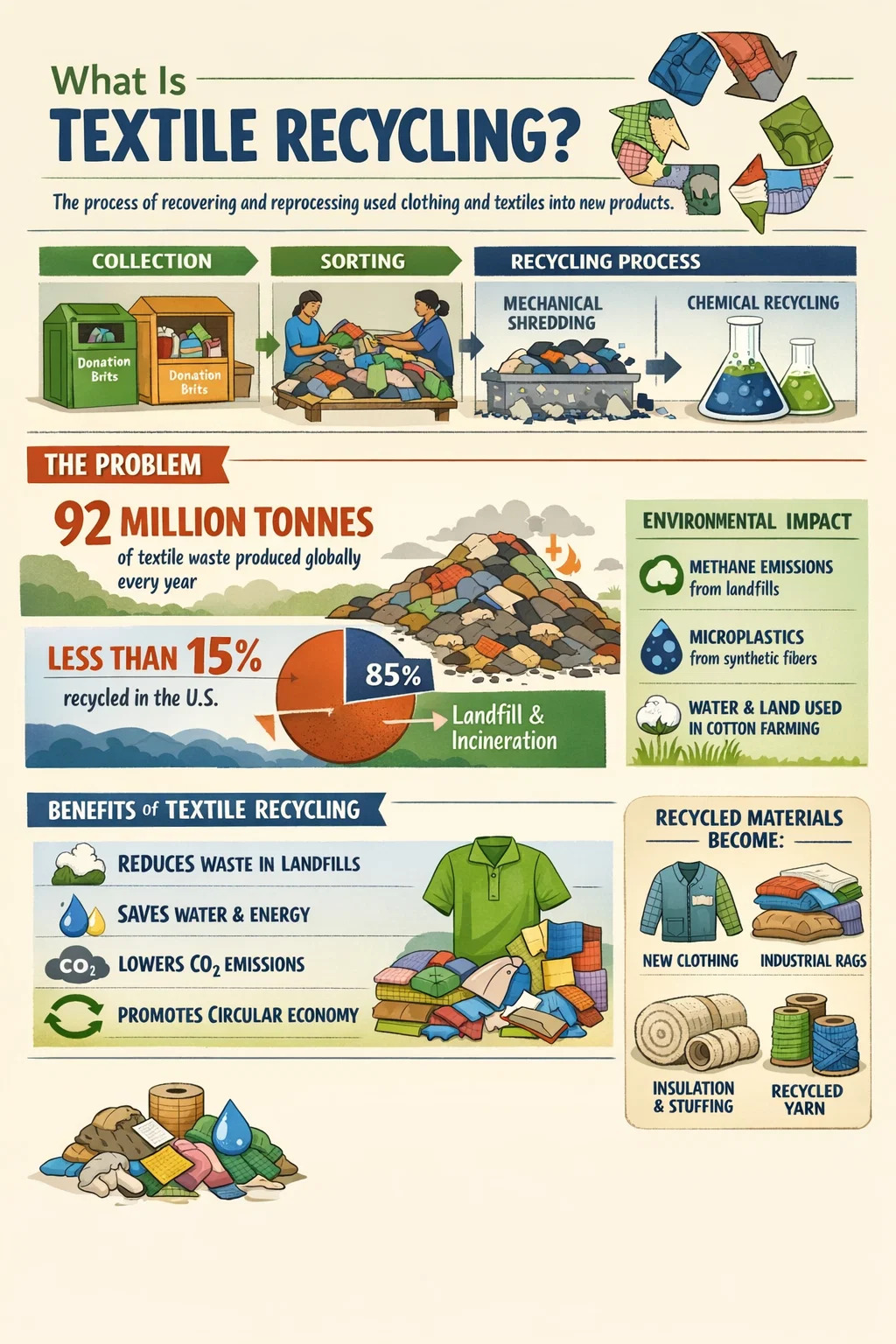
Textile recycling is the process of recovering used or discarded clothing, fabrics, and fiber-based materials and reprocessing them into new products — rather than sending them to landfill or incineration. The recovered materials can be turned into new garments, industrial rags, insulation, stuffing, yarn, or raw fiber. In short, it is a system that keeps textiles in circulation and out of waste streams.
The need for this system is urgent. The global fashion industry produces an estimated 92 million tonnes of textile waste every year. In the United States alone, the EPA reports that Americans discard more than 17 million tonnes of textile waste annually, yet less than 15% of that is collected for reuse or recycling. The rest ends up buried in the ground or burned.
Textile recycling applies to a wide range of materials: cotton, polyester, wool, nylon, linen, silk, and blended fabrics. Each requires a different recovery approach depending on fiber type, condition, and contamination level. Among all fiber categories, recycle cotton programs attract the most attention because cotton is both the most widely used natural fiber in the world and one of the most resource-intensive crops to grow.
Why Textile Waste Is a Serious Environmental Problem
Before understanding how textile recycling works, it helps to grasp exactly what happens when textiles are thrown away rather than recovered.
Landfill Breakdown and Methane Emissions
When natural fibers like cotton or wool decompose in landfill conditions — low oxygen, high compression — they release methane, a greenhouse gas with a warming potential roughly 28 times greater than CO₂ over a 100-year period. Synthetic fibers like polyester and nylon do not biodegrade at all; they fragment into microplastics that leach into groundwater and eventually into the food chain.
The Water and Land Cost of Virgin Cotton
Growing one kilogram of virgin cotton requires approximately 10,000 liters of water — enough for one person to drink for nearly 14 years. Cotton farming also accounts for about 16% of all insecticide use worldwide, despite occupying only 2.5% of global agricultural land. Every time a cotton garment is discarded instead of recycled, those embedded environmental costs are wasted entirely.
Carbon Footprint of New Fiber Production
The fashion industry is responsible for around 10% of annual global carbon emissions — more than international aviation and maritime shipping combined, according to the United Nations Environment Programme. Most of that footprint comes from the production of virgin raw materials, dyeing, and finishing. Recycling textiles, particularly when it replaces virgin fiber production, directly cuts into that number.
How Textile Recycling Actually Works: Step by Step
The recycling process differs depending on whether the material is being mechanically broken down or chemically dissolved. Here is a clear walkthrough of the main stages.
Step 1: Collection
Textiles enter the recycling stream through several channels: drop-off bins on streets or in retail stores, charity and thrift store donations, municipal curbside collection, brand take-back programs, and industrial off-cuts from manufacturing facilities. The condition and source of the material largely determines where it goes next.
Step 2: Sorting
Collected textiles are sorted — often by hand — into categories: items suitable for direct reuse as secondhand clothing, items that need to be shredded or broken down, and waste that cannot be processed. Sorters evaluate fiber type, color, cleanliness, and structural integrity. This sorting stage is labor-intensive and remains one of the biggest bottlenecks in scaling textile recycling globally. Some facilities are now introducing near-infrared (NIR) sensor technology to automate fiber identification, but hand-sorting still dominates at most plants.
Step 3: Fiber Recovery — Mechanical vs. Chemical Methods
Once sorted, textiles move into one of two processing routes:
- Mechanical recycling: Fabrics are shredded by machines fitted with rotating drums and metal spikes. This pulls the fabric apart into individual fibers or fiber clusters, known as "shoddy." The resulting material can be re-spun into new yarn or used as filling for mattresses, car seat padding, or building insulation. The downside is that mechanical shredding shortens fiber length, reducing the strength and quality of the recovered material.
- Chemical recycling: More advanced technologies dissolve textiles in solvents or apply chemical reactions to break fibers down to their molecular building blocks. This allows the regeneration of high-quality fiber that matches virgin material in strength and texture. Chemical recycling is particularly promising for blended fabrics, which mechanical methods struggle to separate. Companies like Renewlone, Infinited Fiber, and Evrnu are operating at various stages of commercial scale using this approach.
Step 4: Re-spinning and Manufacturing
Recovered fibers are cleaned, blended if necessary, and re-spun into new yarn. That yarn is then woven or knitted into fabric, which can be cut and sewn into new garments or industrial textiles. The entire process mirrors conventional textile manufacturing — except the raw material comes from old clothes rather than a farm or a petrochemical plant.
Recycle Cotton: Why It Stands Apart from Other Fibers
Cotton deserves its own section. It is the most consumed natural textile fiber globally, accounting for roughly 25% of total fiber use in clothing. Because of that volume, programs designed to recycle cotton have an outsized potential impact on both resource conservation and emissions reduction.
What Happens When You Recycle Cotton
When cotton garments are collected and processed through mechanical recycling, the fabric is shredded into fiber form. Those recovered fibers are then blended — typically with a small percentage of virgin cotton or a binding synthetic — to compensate for the shortened staple length caused by shredding. The resulting yarn is used for new fabrics, often marketed as recycled cotton or post-consumer recycled (PCR) cotton.
Recycled cotton uses up to 80% less water and produces roughly 50% fewer carbon emissions compared to producing the same weight of virgin cotton fiber. These savings make it one of the most compelling sustainability upgrades available to apparel manufacturers without requiring radical changes to production infrastructure.
The Challenge of Cotton Blends
The main technical barrier to scaling recycle cotton programs is fiber blending. Most modern clothing is not 100% cotton — it is 60% cotton and 40% polyester, or some other combination. Mechanical recycling cannot separate these two fiber types cleanly. The result is a mixed-fiber shoddy that is lower in quality and value than pure cotton or pure polyester recovered material.
Chemical separation technologies are being developed specifically to solve this problem. For example, Worn Again Technologies uses a solvent-based process to dissolve polyester out of a cotton-poly blend, recover both fibers separately, and produce virgin-equivalent material from each. The process is currently in pilot scale and moving toward commercial deployment.
Brands Already Using Recycled Cotton
Several major brands have committed to using recycled cotton content in their products:
- H&M runs a global garment collection program and incorporates mechanically recycled cotton into its Conscious Collection lines.
- Levi's has developed a Water<Less® process and partnered with Cotton Incorporated and other suppliers to incorporate post-consumer recycled cotton into denim production.
- Patagonia uses recycled cotton sourced from cutting-room floor waste and collected garments in several of its product lines, targeting 100% recycled or responsibly sourced materials over time.
- IKEA incorporates recycled cotton into its textile home goods, particularly towels and rugs, through its partnership with the Better Cotton Initiative and its own take-back schemes.
Types of Textile Recycling: Open-Loop vs. Closed-Loop
Not all textile recycling results in new clothing. It is useful to understand the distinction between open-loop and closed-loop recycling, as the two serve very different purposes and have different sustainability implications.
| Feature | Open-Loop Recycling | Closed-Loop Recycling |
|---|---|---|
| Output product | Different product (e.g., insulation, rags) | Same or equivalent product (new garment) |
| Fiber quality required | Low to medium | High |
| Technology needed | Mostly mechanical | Mechanical or chemical |
| Replaces virgin fiber? | Partially | Directly |
| Current scale | Widely available | Emerging/limited |
Open-loop recycling is more established and handles larger volumes today. Closed-loop recycling — turning old clothes into new clothes — is the long-term goal of the circular fashion economy, but it currently represents a very small share of actual textile waste processed worldwide.
Pre-Consumer vs. Post-Consumer Textile Recycling
Textile recycling also divides into two material streams based on where the waste originates.
Pre-Consumer Recycling
Pre-consumer waste refers to scraps, off-cuts, and defective pieces that never reach a consumer — they are generated inside the manufacturing process itself. Approximately 15–20% of fabric is wasted as cutting room scraps during garment production. Recovering these off-cuts and re-spinning them into new yarn is technically simpler than processing post-consumer waste because the fiber is clean, consistent, and uncontaminated. Many brands label pre-consumer recycled content in their products as a sustainability credential.
Post-Consumer Recycling
Post-consumer waste is clothing and textiles that have already been worn and discarded. This is the harder and more impactful stream to tackle, because the material is dirtier, more varied, and often in blended fabric forms. Post-consumer recycled (PCR) cotton, for example, requires sorting through donations, washing contaminated items, and dealing with wide variation in fiber quality and color. Despite the difficulty, PCR materials carry a stronger sustainability argument because they directly divert waste that would otherwise go to landfill.
What Happens to Donated Clothes That Are Not Reworn
Many people assume that donating clothes to a charity shop means those clothes will be worn again by someone else. In reality, only a fraction of donated clothing is resold directly. The rest moves through a cascade of downstream markets and processes.
- Direct resale (secondhand retail): Items in good condition are sold in thrift stores or online platforms. This extends garment life and displaces new purchases — the most resource-efficient outcome.
- Export to secondary markets: Clothing that cannot be sold locally is often baled and shipped to markets in Sub-Saharan Africa, South and Southeast Asia, and Eastern Europe. Countries like Ghana, Kenya, and Pakistan receive millions of tonnes of secondhand garments annually. This market is facing increasing scrutiny and regulatory pressure as local industries are sometimes undercut by low-cost imported used clothing.
- Wiping rags and industrial cloths: Garments too worn for resale are cut into standard-sized rags used in manufacturing, automotive, and maintenance industries.
- Fiber shredding: Items unsuitable for any other use are shredded into shoddy fiber for stuffing or insulation — the core of mechanical textile recycling.
- Landfill or incineration: Contaminated, moldy, or highly degraded items that cannot be processed any other way are ultimately disposed of.
Understanding this cascade matters because it shows that donation does not automatically equal recycling or even reuse. The condition and fiber composition of a garment at the point of donation determines its eventual fate.
Key Environmental Benefits of Textile Recycling
The case for scaling textile recycling rests on a set of measurable environmental advantages. These are not abstract claims — there are life cycle assessment (LCA) studies that quantify them across fiber types.
| Fiber Type | Water Saved | CO₂ Reduction | Energy Reduction |
|---|---|---|---|
| Recycled Cotton | Up to 80% | ~50% | ~45% |
| Recycled Polyester | ~50% | ~50–75% | ~30–50% |
| Recycled Wool | ~60% | ~30% | ~40% |
| Recycled Nylon | ~70% | ~80% | ~45% |
Beyond resource savings, textile recycling reduces pressure on agricultural land, limits pesticide and fertilizer runoff into waterways, and decreases the volume of waste requiring landfill space. These benefits compound at scale — every percentage point increase in textile recovery rates translates into significant real-world environmental relief.
Barriers Preventing Textile Recycling from Scaling Faster
Despite the clear environmental case, textile recycling globally handles only a fraction of available waste. The barriers are both technical and economic.
Mixed-Fiber Problem
As discussed in the context of recycle cotton, most modern garments combine multiple fiber types. An estimated 60% of all clothing sold globally is made from blended fabrics, meaning it cannot be cleanly processed by existing mechanical recycling equipment. Until chemical separation technologies become commercially viable and affordable, blended textiles remain extremely difficult to recycle effectively.
Economics of Virgin vs. Recycled Fiber
Virgin polyester, made from petroleum, is often cheaper than mechanically recycled polyester because oil prices do not account for environmental externalities. Similarly, virgin cotton sourced from low-wage agricultural regions can undercut the cost of recycled cotton, which requires expensive collection, sorting, and processing infrastructure. Without policy intervention — such as carbon pricing, extended producer responsibility (EPR) schemes, or tax incentives for recycled content — market economics often favor virgin material.
Consumer Behavior and Collection Infrastructure
Even when people want to recycle their clothing, they often do not know how or where. Drop-off points are unevenly distributed, and many consumers are unaware that clothing can be recycled in the first place. Studies show that most people still discard clothing in general household waste, even in countries where textile recycling bins are available. Improving collection infrastructure and consumer education are prerequisites for any significant increase in recycling rates.
Quality Degradation Through Mechanical Processing
Each pass through mechanical recycling shortens fiber length, reducing the strength and usability of the recovered material. A cotton garment can typically only go through mechanical recycling once or twice before the fibers are too short to spin into usable yarn. This limits the potential for true circular loops in mechanical systems and is one reason chemical recycling research has attracted substantial investment.
Policy and Industry Developments Driving Change
Regulatory pressure and corporate commitments are beginning to reshape the economics of textile recycling in meaningful ways.
The European Union's Textile Strategy
The EU has taken the most aggressive regulatory position globally. Under its Strategy for Sustainable and Circular Textiles, all EU member states were required to establish separate collection systems for textiles by January 2025. The EU is also developing eco-design regulations that would require textiles to be durable, repairable, and recyclable by design — limiting the use of harmful substances and pushing manufacturers toward mono-material or easily separable fabrics.
Extended Producer Responsibility (EPR)
France became the first country in the world to implement a textile EPR scheme in 2007, requiring brands to fund collection and sorting infrastructure through a fee system managed by the non-profit organization Refashion (formerly Eco TLC). Other countries, including Sweden, the Netherlands, and several Canadian provinces, are developing or piloting similar frameworks. EPR shifts the financial burden of end-of-life textile management from municipalities and taxpayers onto the companies that produce the garments.
Investment in Chemical Recycling Startups
Venture capital and strategic investment from major apparel companies is flowing into chemical recycling technology at an accelerating pace. Notable recent investments include H&M Group's backing of Renewlone and Infinited Fiber, Patagonia's support for Bionic Yarn and fiber recovery research, and PVH Corp's partnerships with various chemical recycling startups. These investments suggest that the industry sees chemical recycling — and particularly closed-loop cotton-to-cotton systems — as the eventual solution to the blended fiber problem.
How to Participate in Textile Recycling as an Individual
Individual action, at scale, contributes meaningfully to total textile recovery rates. Here are practical options available to most consumers.
Brand Take-Back Programs
Many clothing retailers now run in-store take-back programs where customers can drop off old clothing regardless of brand or condition. Examples include H&M's Garment Collecting initiative, Zara's clothing boxes, Mango Commit, and The North Face's Clothes the Loop program in partnership with ThredUp. Some programs offer discount vouchers as an incentive. It is worth checking whether the retailer has published data on what actually happens to collected garments — the best programs provide transparent downstream reporting.
Municipal and Charity Collection Points
Clothing banks and charity drop-off points accept garments in a range of conditions. Even items that are too worn for resale can often be channeled into mechanical recycling streams by collection organizations. In the UK, organizations like TRAID and the Salvation Army run large-scale textile collection and sorting operations. In the US, companies like USAgain and I:CO (now part of Soex Group) operate collection infrastructure at scale.
Sell or Donate Wearable Items Through Resale Platforms
For items still in good condition, resale is always the preferred option before recycling. Platforms like ThredUp, Depop, Vinted, Poshmark, and eBay make peer-to-peer secondhand sales accessible. Extending the life of a garment by even nine additional months reduces its carbon, water, and waste footprint by around 20–30%, according to the Ellen MacArthur Foundation.
Avoid Wishcycling
Wishcycling — putting items in recycling bins in the hope they will be recycled even when they cannot be — creates problems downstream by contaminating batches of recoverable material. Wet, mouldy, or heavily soiled clothing should not go into textile collection bins because it can ruin entire bales of otherwise recyclable material. When in doubt, check the specific requirements of the collection program you are using.
The Future of Textile Recycling: What to Expect
The trajectory of textile recycling is toward higher volumes, better technology, and tighter regulatory frameworks — but the pace of change depends heavily on investment and policy alignment.
In the near term, the most significant development will be the commercial scaling of chemical recycling technologies capable of handling cotton-polyester blends. If even two or three of the current pilot-scale operations — Worn Again, Infinited Fiber, Circ — reach industrial scale within the next five years, it would unlock a genuinely large volume of post-consumer textile waste that currently has nowhere to go.
Digital product passports, being developed under EU eco-design regulations, would attach machine-readable information to garments at the point of manufacture — fiber composition, dyes used, production location — making sorting faster and more accurate at end of life. This kind of embedded data infrastructure could fundamentally change the economics of sorting and significantly improve the quality of recovered fiber.
The Global Fashion Agenda projects that if textile-to-textile recycling rates reach 25% by 2030, the industry could avoid approximately 3 million tonnes of CO₂ equivalent annually. That is a meaningful but achievable target — provided the collection infrastructure, processing technology, and policy environment align within this decade.
For cotton specifically, the opportunity is particularly large. A world where a significant share of the cotton used in new garments comes from recovered post-consumer sources rather than freshly irrigated fields would represent a structural shift in how the fashion industry interacts with water, land, and agricultural ecosystems. Recycle cotton is not just a marketing label — at scale, it is a meaningful mechanism for reducing one of the most resource-intensive supply chains on earth.
Quick Links
Products
Fill in your information here
