


 English
 中文简体
中文简体 عربى
عربى
NEWS
Search by posts
Calendar
Industry News
 By Admin
Is Spun Polyester Better Than Polyester? A Full Comparison
Content
- 1 The Short Answer: It Depends on What You Need
- 2 How Spun Polyester Is Made — and Why It Matters
- 3 Key Property Comparison: Spun Polyester vs Regular Polyester
- 4 Where Spun Polyester Clearly Wins
- 5 Where Regular (Filament) Polyester Has the Edge
- 6 Pilling: The Main Weakness of Spun Polyester
- 7 Spun Polyester vs Cotton: What the Comparison Actually Means
- 8 Thread Count, GSM, and Yarn Count: What Specs Actually Tell You
- 9 Environmental Considerations: Recycled Spun Polyester
- 10 How to Choose the Right Type for Your Specific Application
- 11 Final Verdict: Spun Polyester Is Better — for the Right Jobs
The Short Answer: It Depends on What You Need
Spun polyester and regular polyester (typically filament polyester) are both made from the same base polymer — polyethylene terephthalate (PET) — but they are manufactured differently and behave very differently in real-world applications. Spun polyester is generally considered better for softness, breathability, and a cotton-like feel, while filament polyester excels in strength, sheen, moisture resistance, and durability under harsh conditions. Neither is universally superior. The right choice depends entirely on what the fabric will be used for.
To understand why, you need to look at how each type is made, what physical properties result from that process, and how those properties translate into performance across different end uses — from activewear and workwear to home textiles and outdoor furniture.
How Spun Polyester Is Made — and Why It Matters
Standard filament polyester is extruded as long, continuous strands from molten polymer. These filaments are smooth, uniform, and unbroken from end to end. The resulting yarn is sleek and has a slight sheen that many people associate with synthetic fabrics.
Spun polyester, on the other hand, starts with either cut staple fibers or recycled polyester that has been broken into short lengths — typically between 38mm and 64mm, similar to cotton staple lengths. These short fibers are then spun together using ring spinning, open-end spinning, or air-jet spinning to create a yarn. This spinning process causes the fiber ends to protrude slightly from the yarn surface, creating a texture that closely resembles cotton or wool.
This fundamental structural difference — short twisted fibers versus long continuous filaments — drives virtually every performance difference between the two materials. The surface texture of spun polyester traps small air pockets, which contributes to better thermal comfort and a softer hand feel. Filament polyester's smooth surface offers less friction and better moisture-wicking in certain constructions.
Ring-spun polyester, a subset of spun polyester, involves twisting fibers in a tighter, more refined process. This produces a particularly smooth, strong, and consistent yarn that is widely used in premium T-shirts, sportswear, and fine linens. Ring-spun spun polyester fabric is measurably softer than open-end spun alternatives — often cited as 20–30% softer in tactile assessments by textile manufacturers.
Key Property Comparison: Spun Polyester vs Regular Polyester
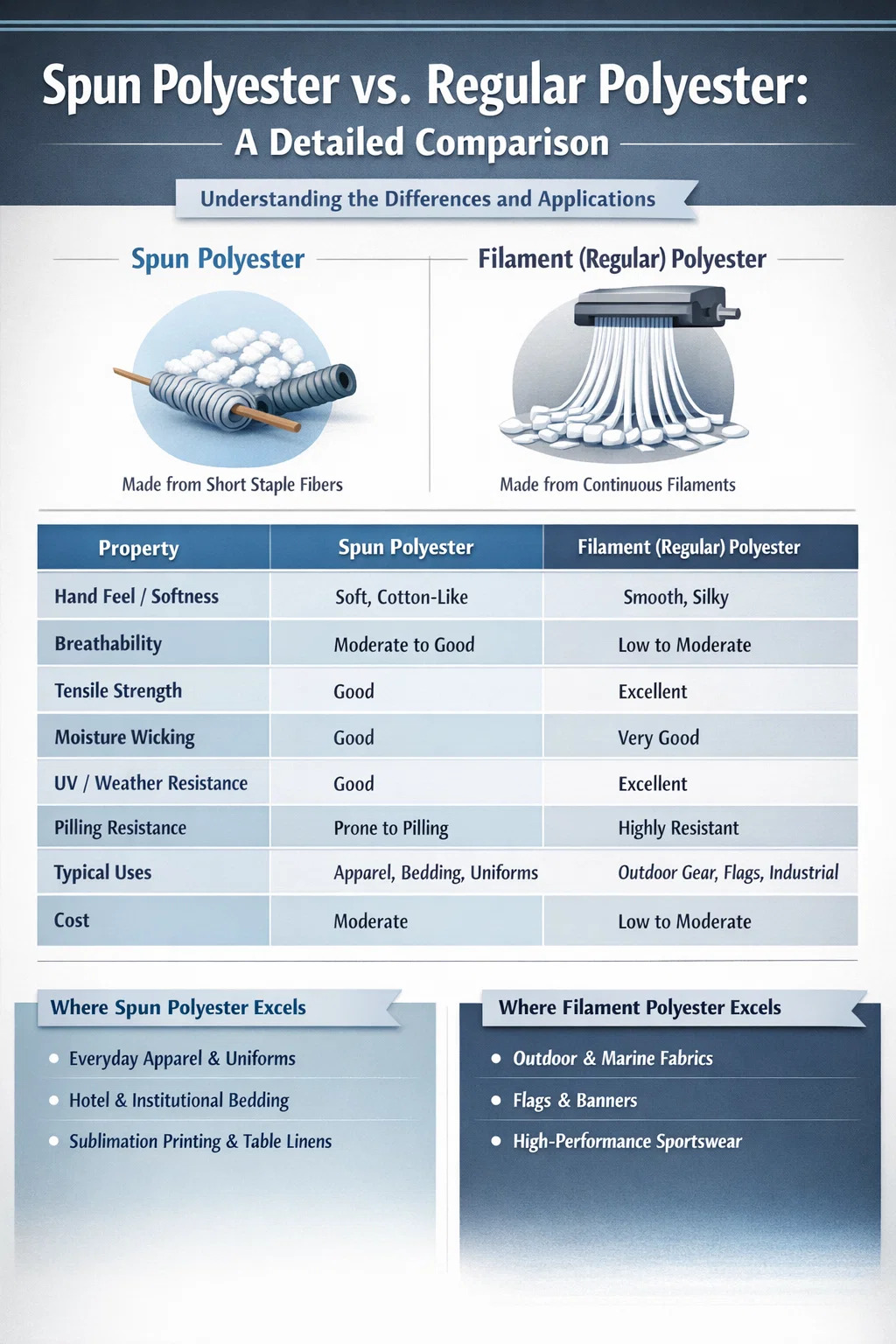
The table below summarizes the most important performance differences between spun polyester and filament (regular) polyester across the properties that matter most to buyers and manufacturers:
| Property | Spun Polyester | Filament (Regular) Polyester |
|---|---|---|
| Hand Feel / Softness | Soft, cotton-like, matte | Smooth, silky, slight sheen |
| Breathability | Moderate to good | Low to moderate |
| Pilling Resistance | Moderate (fibers can pill) | High (no loose fiber ends) |
| Tensile Strength | Good | Excellent |
| Moisture Wicking | Good (depends on construction) | Very good (smooth surface) |
| UV / Weather Resistance | Good | Excellent |
| Print Clarity (Sublimation) | Good to very good | Excellent |
| Cost | Moderate | Low to moderate |
| Wrinkling | Low wrinkle tendency | Very low wrinkle tendency |
| Typical Applications | Apparel, bedding, uniforms, home textiles | Outdoor fabric, sportswear, flags, industrial |
Where Spun Polyester Clearly Wins
There are specific categories where spun polyester consistently outperforms its filament counterpart, and understanding these helps narrow down the right material for a given product.
Everyday Apparel and Uniforms
Spun polyester fabric has become the dominant choice for workwear, polo shirts, school uniforms, and corporate apparel. The reason is straightforward: it looks and feels more like cotton, which most people prefer against their skin for extended wear. A typical spun polyester polo has a thread count in the range of 50s to 80s (yarn count), which produces a fabric with a noticeably softer surface than a comparable filament woven shirt.
Spun polyester also holds its shape and color far better than cotton over repeated washing. Industrial laundry tests consistently show spun polyester garments maintaining acceptable color fastness after 50+ wash cycles at 60°C, compared to cotton blends that typically show significant fading by cycle 30.
Hotel and Institutional Bedding
In the hospitality industry, spun polyester thread counts between 200 and 400 are the standard for budget to mid-range hotels. The material resists shrinkage, dries faster than cotton (reducing energy costs in commercial laundry operations), and withstands high-temperature washing for hygiene compliance. A set of spun polyester sheets weighing roughly 110–130 GSM will maintain dimensional stability through hundreds of industrial wash cycles — something pure cotton cannot match without significant shrinkage.
For home consumers, spun polyester bed sheets offer a practical alternative to expensive Egyptian cotton. While they don't absorb moisture quite as well as natural fibers, modern microfiber spun polyester sheets with a GSM of 90–110 can feel indistinguishable from cotton blends to most users, at a fraction of the price.
Sublimation Printing on Performance Wear
Spun polyester with a high polyester content (90% or above) accepts sublimation dye printing with excellent color vibrancy and sharpness. Sports jerseys, cycling kits, and custom athletic wear are frequently made from spun polyester precisely because it combines a better wearing feel with strong print retention. The slightly textured surface of spun polyester actually helps ink dispersion during the sublimation process, reducing bleed and producing crisper detail at fine print edges compared to some woven filament alternatives.
Table Linens and Food Service Textiles
Spun polyester tablecloths and napkins dominate the food service industry for several practical reasons. They are inherently stain-resistant compared to cotton, release soil during washing more readily, and do not require ironing after machine drying if removed promptly. Restaurant supply chains typically specify spun polyester fabrics at 200–250 GSM for tablecloths, balancing weight (to drape properly) with wash durability. The matte finish of spun polyester also creates a more formal appearance suitable for dining settings, unlike the slight gloss associated with filament woven polyester.
Where Regular (Filament) Polyester Has the Edge
Filament polyester is not simply an inferior version of spun polyester — it genuinely outperforms spun polyester in several important application areas.
Outdoor and Marine Applications
For outdoor furniture upholstery, marine canvas, awnings, and patio cushions, solution-dyed filament polyester is the material of choice. The continuous filament structure offers superior resistance to UV degradation, tearing, and moisture absorption. Fabrics like Sunbrella (a branded solution-dyed acrylic that competes in the same space) and many commercial outdoor polyester fabrics are engineered to withstand UV exposure ratings of 1,000+ hours on the Xenon arc test. Spun polyester would degrade faster under the same conditions because the protruding staple fiber ends are more susceptible to UV and abrasion damage.
Flags and Banners
Knitted filament polyester is the standard material for outdoor flags globally. Its open knit construction allows wind to pass through, reducing stress on the fabric and flagpole fittings. Filament polyester flags are light, strong, and retain color well when printed with UV-resistant inks. A standard outdoor flag made from 75D or 100D filament polyester will typically outlast a spun polyester version by a considerable margin in continuous outdoor flying conditions, where abrasion and UV exposure are constant factors.
High-Performance Sportswear Liners and Activewear Shells
For moisture management in competitive sports garments, fine-denier filament polyester microfibers (below 1 denier per filament, sometimes called ultra-microfiber) are engineered to wick sweat away from the skin surface extremely rapidly. The smooth filament structure creates capillary channels that transport moisture outward faster than the more random fiber arrangement of spun polyester. Elite running shirts and cycling base layers often use filament polyester for this reason. That said, spun polyester knit fabrics with open constructions can still perform adequately for casual athletics and gym wear.
Industrial and Technical Textiles
Where raw tensile strength, tear resistance, and dimensional stability matter above all else — geotextiles, filter fabrics, conveyor belts, and similar applications — filament polyester is preferred. The unbroken fiber structure provides higher breaking strength per unit of weight than spun equivalents. In geotextile applications, nonwoven filament polyester fabrics rated at 200 kN/m tensile strength are routine, a spec that spun polyester constructions would struggle to match at comparable weights.
Pilling: The Main Weakness of Spun Polyester
One of the most common complaints about spun polyester fabrics is pilling — those small, fuzzy balls that form on the surface of the fabric after repeated washing and wearing. Pilling occurs when loose fiber ends on the fabric surface tangle together and form compact knots. Because spun polyester is built from short fibers with exposed ends, it is inherently more prone to pilling than filament polyester.
Higher-quality spun polyester, particularly ring-spun varieties, pills significantly less than cheaper open-end spun alternatives. This is because ring spinning creates a tighter, more compact yarn structure with fewer protruding fiber ends. Brands that specify "ring-spun polyester" in their product descriptions are specifically addressing this concern.
Fabric construction also plays a role. Tightly woven spun polyester fabrics — such as twill or oxford weaves — pill less than loosely knit equivalents because friction between yarn and surface is reduced. For applications where appearance longevity is critical, such as hospitality uniforms or branded workwear, specifying a tighter weave and a higher yarn count mitigates the pilling problem substantially.
To put this in perspective, the Martindale abrasion test — a standard industry measure of surface durability — typically rates high-quality spun polyester fabrics at 20,000–40,000 rub cycles before showing significant pilling or wear, compared to 50,000+ for many filament polyester fabrics. For most everyday garment applications, even 20,000 cycles is more than sufficient, but for upholstery or heavy-use applications, filament polyester's advantage is meaningful.
Spun Polyester vs Cotton: What the Comparison Actually Means
Much of the appeal of spun polyester comes from its comparison to cotton, not just to filament polyester. Spun polyester was, in many respects, developed specifically to approximate cotton's comfort while offering synthetic performance benefits. Here is where that comparison stands in practical terms:
- Spun polyester dries approximately 3–5 times faster than cotton of comparable weight, a significant advantage in humid climates or high-wash environments.
- Spun polyester has virtually zero shrinkage over its service life, while 100% cotton typically shrinks 3–5% after the first wash and can accumulate up to 10% shrinkage over time.
- Cotton absorbs approximately 8% of its weight in moisture before feeling wet. Spun polyester absorbs far less (under 1%), which can feel clammy in hot conditions if the fabric construction does not allow airflow.
- Spun polyester retains color through significantly more wash cycles than cotton, particularly in darker or brighter colorways. Reactive-dyed cotton begins to fade noticeably after 20–25 washes at 40°C; disperse-dyed spun polyester maintains acceptable color for 50–75 washes at comparable temperatures.
- Cotton remains biodegradable at end of life; spun polyester does not degrade in natural environments, which is an environmental consideration that increasingly influences purchasing decisions.
For buyers who want the feel of cotton with better performance, a 65% polyester / 35% cotton blend using spun polyester is often considered the practical optimum — combining cotton's breathability and natural feel with spun polyester's dimensional stability, color retention, and durability.
Thread Count, GSM, and Yarn Count: What Specs Actually Tell You
When evaluating spun polyester products, three technical specifications matter most and are frequently misunderstood or misrepresented in marketing.
GSM (Grams per Square Meter)
GSM measures fabric weight and is the most reliable indicator of fabric substance. For spun polyester applications:
- 80–120 GSM: Lightweight shirts, liners, summer apparel
- 130–180 GSM: Standard polo shirts, mid-weight uniforms, bedding
- 200–280 GSM: Heavyweight workwear, table linens, durable upholstery
- 300+ GSM: Heavy-duty applications, outdoor cushions, exhibition fabrics
Thread Count (TC)
Thread count — the number of threads per square inch — is most relevant for woven spun polyester fabrics like bedsheets. A common misconception is that higher thread count always means better quality. In spun polyester, a thread count of 200–400 represents genuinely high-quality fabric. Counts advertised above 400 in polyester bedding are frequently achieved by twisting multi-ply yarns and counting each ply separately, which inflates the number without actually improving the fabric's feel or durability.
Yarn Count (Ne)
Yarn count in the English cotton count system (Ne) indicates the fineness of the spun yarn. Higher Ne values mean finer, softer yarn. A spun polyester shirt made from Ne 40s yarn will feel noticeably softer and lighter than one made from Ne 20s yarn. For premium apparel applications, Ne 60s to Ne 80s ring-spun polyester yarn produces fabric comparable in softness to fine cotton while retaining the performance advantages of the synthetic fiber.
Environmental Considerations: Recycled Spun Polyester
One area where spun polyester has a growing advantage over filament polyester is in the production of recycled content fabrics. Recycled polyester (rPET), made from post-consumer plastic bottles and textile waste, is most commonly produced in staple fiber form — which means it feeds directly into the spun polyester manufacturing process.
Producing recycled polyester staple fiber uses approximately 30–50% less energy than virgin polyester fiber production, according to assessments by textile certification organizations. A single 500ml PET bottle yields approximately 27 grams of recycled polyester fiber — enough for roughly a quarter of a standard T-shirt.
Many major apparel brands — including Patagonia, Adidas, and H&M — have committed to using significant proportions of recycled polyester in their spun polyester products. GRS (Global Recycled Standard) and OEKO-TEX certifications are the primary third-party standards consumers should look for when evaluating claims about recycled spun polyester content.
It is worth noting that all polyester — spun or filament, virgin or recycled — sheds microplastic fibers during washing. Research published in scientific journals has identified synthetic textiles as a significant source of microplastic pollution in aquatic environments. Spun polyester may shed slightly more microfibers than filament polyester due to its looser fiber structure, though this varies considerably by fabric construction and wash conditions. Using a microplastic filter bag (such as a Guppyfriend) during washing reduces shedding by 54–86% according to independent testing.
How to Choose the Right Type for Your Specific Application
Use the following guidance to make a clear decision based on the application:
- Workwear, uniforms, polo shirts: Choose spun polyester, preferably ring-spun, at 150–180 GSM. It will feel better against the skin and hold its appearance through commercial laundering.
- Bedding and pillowcases: Spun polyester at 200–300 TC is the practical choice for institutional settings. For home use, microfiber spun polyester at 90–120 GSM provides a soft, easy-care option.
- Outdoor furniture and cushions: Use solution-dyed filament polyester with UV resistance ratings clearly specified. Spun polyester will degrade faster outdoors.
- Flags and banners: Filament polyester (knitted or woven) is the correct choice for durability and print clarity in outdoor exposure.
- Sports jerseys and custom printed apparel: High-percentage spun polyester (90%+) is ideal for sublimation printing with good wearing comfort.
- Table linens: Spun polyester at 200–250 GSM in a tight weave. Handles staining, commercial washing, and daily use well.
- Technical or industrial textiles: Filament polyester for strength, stability, and moisture resistance without exception.
- Budget-conscious everyday apparel: A 65/35 spun polyester-cotton blend offers the best compromise between comfort, durability, and cost.
Final Verdict: Spun Polyester Is Better — for the Right Jobs
Spun polyester is the better choice in the majority of consumer and commercial textile applications where comfort, appearance, and care performance are the primary criteria. Its cotton-like hand, wrinkle resistance, color durability, and compatibility with recycled fiber production give it real, measurable advantages in apparel, bedding, and hospitality textiles.
However, "better" is always contextual. For outdoor durability, technical strength, and high-performance moisture management, filament polyester remains the superior option. The two materials are complements, not competitors — and the best textile manufacturers use each where its properties are genuinely suited to the demand.
When you see "spun polyester" on a product label or specification sheet, treat it as a positive indicator for softness, washability, and everyday wearability. When you need something to endure the outdoors, extreme abrasion, or industrial stress, look instead to the proven performance of filament polyester fabrics. Knowing the difference means you will choose better fabric for every application — and avoid the disappointment of picking the wrong material for the wrong job.
Quick Links
Products
Fill in your information here
