


 English
 中文简体
中文简体 عربى
عربى
NEWS
Search by posts
Calendar
Industry News
 By Admin
What Are Natural Fibers? Cotton, Wool, Hemp & Recycle Cotton
Content
- 1 What Are Natural Fibers — A Direct Answer
- 2 Plant-Based Natural Fibers: Cotton, Linen, Hemp, and More
- 3 Animal-Based Natural Fibers: Wool, Silk, Cashmere, and Alpaca
- 4 Comparing Major Natural Fibers: Properties at a Glance
- 5 Recycle Cotton: How It Works and Why It Matters
- 6 Natural Fibers vs Synthetic Fibers: Key Differences
- 7 Sustainability Certifications for Natural and Recycled Natural Fibers
- 8 Industrial and Technical Applications of Natural Fibers
- 9 How to Source and Evaluate Natural Fibers as a Buyer
- 10 The Future of Natural Fibers: Circular Systems and Innovation
- 11 Frequently Asked Questions About Natural Fibers
- 11.1 What is the difference between natural fibers and organic fibers?
- 11.2 Is recycle cotton the same quality as virgin cotton?
- 11.3 How do I know if a product actually contains recycle cotton?
- 11.4 Which natural fiber has the lowest environmental impact?
- 11.5 Can natural fibers be used in performance sportswear?
What Are Natural Fibers — A Direct Answer
Natural fibers are raw materials derived directly from plants, animals, or minerals without synthetic chemical manufacturing. They are spun into yarn or thread and then woven, knitted, or otherwise processed into textiles. Unlike synthetic fibers such as polyester or nylon — which are made from petroleum-based polymers — natural fibers come from biological sources that grow or are produced in nature. Cotton, wool, linen, silk, jute, hemp, and cashmere are among the most commercially significant natural fibers in the world today.
According to the Food and Agriculture Organization of the United Nations (FAO), natural fibers account for roughly 35% of global fiber consumption, with cotton alone representing approximately 25% of that total. Their popularity spans thousands of years of human civilization, from ancient Egyptian linen to Chinese silk, and they continue to dominate premium textile markets because of their breathability, biodegradability, and comfort properties that most synthetics still struggle to replicate.
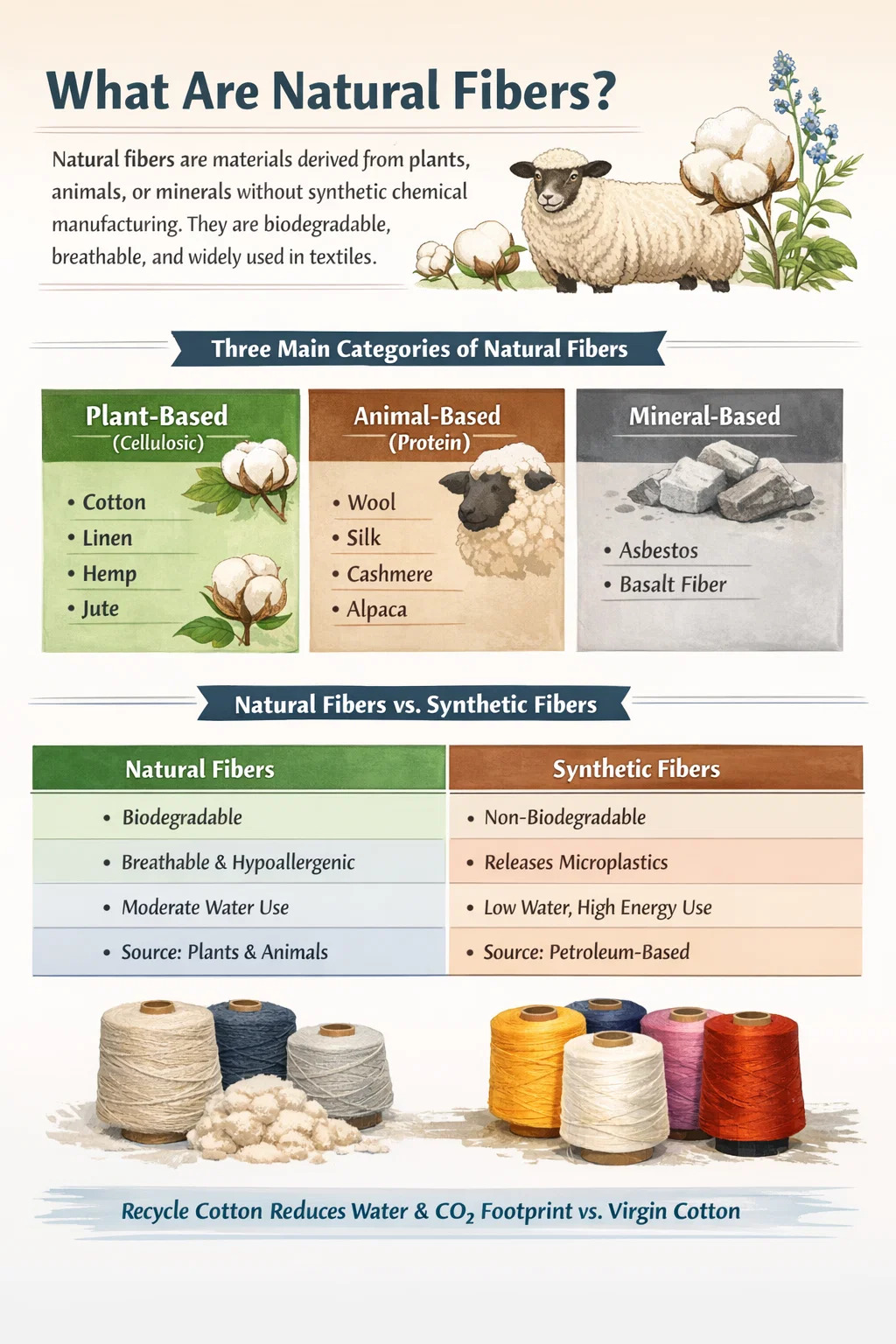
Natural fibers are broadly classified into three categories: plant-based (cellulosic), animal-based (protein), and mineral-based. Each category has distinct structural properties, processing requirements, and end-use applications. Understanding these distinctions is essential for sourcing the right material — whether for apparel, industrial textiles, medical applications, or sustainable product development.
Plant-Based Natural Fibers: Cotton, Linen, Hemp, and More
Plant-based fibers, also called cellulosic fibers, are composed primarily of cellulose — a natural polymer found in the cell walls of plants. They tend to be strong, moisture-absorbent, and relatively easy to dye. The most important plant-based natural fibers include:
Cotton
Cotton is the world's most widely used natural fiber. It grows as a soft, fluffy staple fiber around the seeds of the cotton plant (Gossypium species), primarily cultivated in the United States, India, China, Brazil, and Pakistan. Global cotton production hovers around 25–26 million metric tons per year. Cotton is valued for its softness, breathability, hypoallergenic properties, and versatility across apparel, home textiles, and medical products.
One increasingly critical dimension of cotton is its circular use through recycle cotton — also known as recycled cotton or regenerated cotton. Recycle cotton is produced by breaking down post-industrial or post-consumer cotton waste back into fiber form, which can then be spun into new yarn. This process dramatically reduces water usage (conventional cotton requires approximately 1,500–2,000 liters of water per kilogram of fiber) and eliminates the need for additional land cultivation and pesticide application. Brands sourcing recycle cotton can reduce their carbon footprint by up to 45% compared to virgin cotton production, according to lifecycle assessment data from the Textile Exchange.
Linen (Flax)
Linen comes from the stalks of the flax plant (Linum usitatissimum). It is one of the oldest known textiles — fragments of linen have been found in ancient Egyptian tombs dating back more than 5,000 years. Linen is stronger than cotton, naturally antimicrobial, and becomes softer with each wash. It is particularly popular in warm-climate apparel and high-end home textiles such as bed sheets and tablecloths. Major producing countries include France, Belgium, and China.
Hemp
Hemp fiber comes from the Cannabis sativa plant and is one of the most durable plant-based natural fibers available. Hemp requires no pesticides, minimal water, and actually improves soil health through phytoremediation. Its tensile strength is approximately three times greater than cotton, making it suitable for industrial textiles, rope, canvas, and increasingly, fashion apparel. Hemp blended with recycle cotton is gaining traction as a high-sustainability textile option.
Jute
Jute is a long, soft, shiny bast fiber primarily grown in Bangladesh and India. It is the second most important plant-based fiber by volume after cotton and is widely used in burlap sacks, rope, rugs, and geotextiles. With a global market value exceeding USD 2.5 billion, jute plays a significant economic role in South Asia and is considered one of the most affordable and fully biodegradable packaging materials available.
Bamboo
Though technically a grass, bamboo is processed into textile fiber and is often grouped with plant-based natural fibers. Mechanically processed bamboo (bamboo linen) is genuinely natural; however, most commercially available "bamboo fabric" is chemically processed into bamboo viscose, which involves significant chemical inputs. Consumers should verify processing methods when evaluating bamboo as a natural fiber option.
Animal-Based Natural Fibers: Wool, Silk, Cashmere, and Alpaca
Animal-based fibers, or protein fibers, are composed of amino acid chains — similar in structure to human hair and skin. They offer exceptional thermal regulation, natural elasticity, and flame resistance without chemical treatment. Key animal-based natural fibers include:
Wool
Wool is sheared from sheep and is the dominant animal-based natural fiber globally. Australia, China, and New Zealand are the largest producers. Merino wool — from Merino sheep — is particularly prized for its fineness (measured in microns; Merino typically ranges from 15 to 24 microns) and soft hand feel. Wool's natural crimp creates air pockets that provide insulation, and its moisture-wicking ability makes it suitable for both hot and cold weather. Like recycle cotton, recycled wool (also called shoddy wool) has a long industrial history — Victorian England mills were recycling wool waste as early as the 1800s.
Silk
Silk is produced by silkworms (Bombyx mori) and is the strongest natural fiber by weight. A single silkworm cocoon can yield a continuous filament of 600 to 900 meters. China produces about 75% of the world's silk. Its natural luster, smooth texture, and ability to regulate body temperature have made it a luxury textile material for millennia. Silk is also hypoallergenic and resistant to mold and mildew.
Cashmere
Cashmere comes from the soft undercoat of Cashmere goats, primarily raised in Mongolia, China, and Afghanistan. Each goat produces only 150–200 grams of usable fiber per year, making cashmere one of the most expensive natural fibers in the world. Premium cashmere grades have a fiber diameter below 15 microns — finer than the finest Merino wool. The global cashmere market is valued at approximately USD 3.5 billion annually.
Alpaca
Alpaca fiber comes from alpacas native to the Andean highlands of Peru, Bolivia, and Chile. It is hypoallergenic (lacking the lanolin found in wool), warmer than wool by weight, and available in over 22 natural colors without dyeing. Peru produces roughly 80% of the world's alpaca fiber. Alpaca is increasingly popular in sustainable luxury fashion as an alternative to cashmere, with a lower environmental footprint due to alpacas' gentle grazing habits.
Comparing Major Natural Fibers: Properties at a Glance
The following table summarizes the key performance and sustainability characteristics of the most commercially important natural fibers, including recycle cotton as a distinct category given its growing market presence:
| Fiber | Origin | Key Strengths | Water Use (kg fiber) | Biodegradable | Typical Price Range |
|---|---|---|---|---|---|
| Virgin Cotton | Cotton plant | Soft, breathable, versatile | 1,500–2,000 L | Yes | Low–Medium |
| Recycle Cotton | Post-consumer/industrial waste | Low water, reduced CO₂, circular | ~100–200 L | Yes | Medium |
| Linen | Flax plant | Strong, antimicrobial, cool | ~500 L | Yes | Medium–High |
| Wool | Sheep | Insulating, elastic, fire-resistant | ~170 L | Yes | Medium–High |
| Silk | Silkworm | Lustrous, strong, hypoallergenic | ~400 L | Yes | High |
| Hemp | Cannabis sativa | Very durable, pesticide-free | ~300–400 L | Yes | Medium |
| Cashmere | Cashmere goat | Ultra-soft, lightweight, warm | ~400 L | Yes | Very High |
Recycle Cotton: How It Works and Why It Matters
Recycle cotton — often labeled as recycled cotton, regenerated cotton, or reclaimed cotton — has emerged as one of the most practical and scalable solutions within the sustainable textiles space. It does not grow in a field; instead, it is recovered from two primary sources: post-industrial cotton waste (cutting scraps, spinning waste, and fabric remnants from garment factories) and post-consumer cotton waste (used clothing, household textiles, and worn-out garments collected after consumer use).
The Recycle Cotton Production Process
The process of producing recycle cotton fiber involves several key stages:
- Collection and sorting: Cotton waste is gathered from factories or collected from consumers. It is sorted by color to reduce or eliminate the need for re-dyeing, which is one of the most water- and chemical-intensive steps in textile manufacturing.
- Shredding/garnetting: The sorted textiles are mechanically shredded by garnetting machines, which pull apart the fabric structure and break fibers back down into loose, raw form. This mechanical process avoids the use of harsh solvents.
- Carding: The recovered fibers are carded — passed through rollers with fine wire teeth — to align the fibers and remove any remaining contaminants or non-cellulosic debris.
- Blending: Because mechanical recycling shortens fiber length (which reduces yarn strength), recycle cotton is frequently blended with virgin cotton, recycled polyester, or other fibers to achieve the desired yarn count and tensile strength. A common blend ratio is 70% recycle cotton / 30% recycled polyester, which balances sustainability with functional performance.
- Spinning: The blended fiber is spun into yarn, then knitted or woven into fabric using standard textile machinery.
The environmental advantages of recycle cotton are substantial. Compared to producing virgin cotton, recycle cotton requires no additional land, no pesticides, and up to 98% less water in the fiber production phase. The Global Recycled Standard (GRS) and the Recycled Claim Standard (RCS) are the two most widely accepted third-party certifications that verify recycle cotton content and supply chain integrity.
Market Adoption of Recycle Cotton
Global demand for recycle cotton has grown significantly. Major brands including H&M, Levi Strauss, Patagonia, and Ikea have committed to increasing their use of recycled and sustainably sourced cotton. The global recycled cotton market was valued at approximately USD 5.8 billion in 2022 and is projected to grow at a compound annual growth rate (CAGR) of around 9% through 2030, according to industry research estimates. Spain and Italy — particularly the Prato region near Florence — have been centers of textile recycling for decades, with Prato producing recycle cotton yarns since the 19th century.
The challenge remains fiber shortening — as cotton fibers are recycled multiple times, their staple length decreases, eventually making them unsuitable for high-quality yarn spinning. Chemical recycling technologies, currently in development by companies such as Infinited Fiber Company and Re:newcell, aim to dissolve cotton cellulose back to its molecular building blocks and regenerate new, full-length fibers — potentially enabling truly closed-loop recycle cotton without quality degradation.
Natural Fibers vs Synthetic Fibers: Key Differences
Understanding where natural fibers stand relative to synthetic alternatives helps clarify why they remain essential — and why the push toward recycle cotton and other recycled natural fibers is gaining momentum rather than simply switching to synthetics.
| Category | Natural Fibers | Synthetic Fibers |
|---|---|---|
| Raw Material Source | Plants, animals, minerals | Petroleum-based polymers |
| Biodegradability | Fully biodegradable | Non-biodegradable (100–500 years) |
| Microplastic Release | None | Releases microfibers during washing |
| Breathability | High (especially cotton, linen) | Generally low to moderate |
| Skin Comfort | Generally hypoallergenic | Can cause irritation in some users |
| Production Water Use | Moderate–High (except recycle cotton) | Low water but high energy use |
| End-of-Life Options | Compostable, recyclable | Limited recycling infrastructure |
One concern often raised about natural fibers is the agricultural land and water they consume. This is precisely where recycle cotton and other recycled natural fibers offer the best of both worlds — the inherent comfort and biodegradability of cotton, without the resource burden of growing new crops. Synthetics release microplastics with every wash cycle; a single polyester garment can shed over 700,000 microfibers per wash, according to research published in Environmental Science & Technology. Natural fibers, including recycle cotton, shed cellulose-based particles that biodegrade far more rapidly.
Sustainability Certifications for Natural and Recycled Natural Fibers
With the growing market for sustainable textiles, several credible third-party certifications have been established to validate environmental and social claims. For buyers sourcing natural fibers or recycle cotton, knowing which certifications are meaningful — and what they actually verify — is essential due diligence.
- Global Organic Textile Standard (GOTS): Covers organic natural fibers from harvest through final product. Requires at least 70% certified organic fiber content and prohibits harmful chemicals throughout the supply chain. Widely considered the gold standard for organic cotton and wool.
- Global Recycled Standard (GRS): Third-party verification of recycled content, including recycle cotton. Tracks recycled material from source through processing and certifies supply chain transparency. Requires minimum 20% recycled content for GRS labeling and 50% for GRS product certification.
- Recycled Claim Standard (RCS): Similar to GRS but without the social and environmental processing requirements. Suitable for brands that want to verify recycled content only without broader supply chain audits.
- Better Cotton Initiative (BCI): A field-level program that trains farmers in more sustainable cotton growing practices. Not an organic certification, but focuses on reducing water, pesticide, and fertilizer use. More than 2.9 million farmers participate globally.
- OEKO-TEX STANDARD 100: Tests finished textile products for harmful substances. Does not certify fiber origin or organic status, but verifies that the final product is free from over 100 harmful chemicals. Applicable to products made from virgin and recycle cotton alike.
- Responsible Wool Standard (RWS): Covers animal welfare and land management practices in wool production. Certified RWS wool comes from farms that demonstrate progressive land management and humane treatment of sheep.
For companies integrating recycle cotton into their product lines, GRS certification is currently the most recognized and widely required certification by major retail buyers and sustainability reporting frameworks, including the EU's Corporate Sustainability Reporting Directive (CSRD).
Industrial and Technical Applications of Natural Fibers
Natural fibers are not limited to apparel. Their mechanical properties make them increasingly viable for industrial and technical applications where lightweight, biodegradable alternatives to synthetic composites are needed.
Natural Fiber Composites (NFCs)
Natural fiber composites use plant-based fibers — most commonly jute, hemp, flax, and kenaf — embedded in polymer matrices to create structural materials. The European automotive industry has been a significant driver of NFC adoption. Mercedes-Benz, BMW, and Audi have used flax and jute-based composites in door panels, trunk liners, and headrests since the early 2000s. NFCs are approximately 25–30% lighter than comparable glass fiber composites, which contributes to fuel efficiency and reduced vehicle emissions.
Geotextiles
Jute and coir (coconut fiber) are widely used as biodegradable geotextiles for erosion control, slope stabilization, and revegetation projects. Unlike synthetic geotextiles that remain in the ground indefinitely, natural fiber geotextiles biodegrade within 1–5 years, by which time vegetation roots have stabilized the soil and the textile is no longer needed. This is particularly valuable in ecologically sensitive areas where synthetic material disposal would be problematic.
Medical and Hygienic Textiles
Cotton — including recycle cotton where appropriate — is foundational to medical textiles. Surgical gauze, bandages, hospital bedding, and wound care dressings rely on cotton's absorbency, softness, and sterilizability. Medical-grade cotton must meet strict specifications for fiber purity, absorbency rate, and absence of residual chemicals. For post-consumer recycle cotton, medical applications are limited due to contamination risk, but post-industrial recycle cotton from controlled factory waste is increasingly being evaluated for secondary medical textile uses.
Nonwoven Applications
Recycle cotton fiber is extensively used in nonwoven applications — acoustic insulation panels, thermal insulation, furniture padding, and automotive felt. These applications are less sensitive to fiber length reduction from mechanical recycling, making them ideal end markets for recycle cotton that cannot be spun into high-quality yarn. The automotive insulation market has been one of the largest consumers of recycle cotton nonwovens, using the material to line car doors, floors, and trunk compartments for sound dampening.
How to Source and Evaluate Natural Fibers as a Buyer
Whether you are a product developer, procurement manager, or sustainability officer, evaluating natural fibers requires looking beyond generic material descriptions. Here are the practical criteria to apply:
For Recycle Cotton Specifically
- Verify source classification: Confirm whether the recycle cotton is post-industrial or post-consumer. Post-industrial is typically cleaner and more consistent in fiber quality. Post-consumer offers stronger sustainability narratives but requires more robust sorting and quality control.
- Request GRS certification documents: Do not rely on verbal claims. GRS certificates are publicly verifiable through the Textile Exchange database and should show the specific facility and scope of certification.
- Clarify blend ratios: Ask for the exact percentage of recycle cotton in any blended yarn. Some suppliers use the term loosely to describe products with as little as 20% recycle content.
- Assess fiber length and yarn count compatibility: Shorter recycled fibers produce coarser yarns. If your application requires fine gauge knits or high-thread-count wovens, confirm whether the recycle cotton supplier's fiber specifications match your production requirements.
- Evaluate color sorting capability: Suppliers with strong color-sorting infrastructure can provide pre-sorted, undyed recycle cotton bales, significantly reducing your downstream dyeing needs and chemical use.
For Virgin Natural Fibers
- Request country-of-origin documentation and, for organic claims, GOTS or equivalent certification.
- For wool and specialty animal fibers, request Responsible Wool Standard (RWS) or equivalent certifications to verify animal welfare and land management compliance.
- Request fiber testing reports showing micron count (for fine fibers), staple length, and moisture content — all of which directly affect yarn quality and end-product performance.
- Evaluate chemical treatment history: some natural fibers undergo mercerization, bleaching, or anti-shrink treatments that affect their biodegradability and skin safety.
The Future of Natural Fibers: Circular Systems and Innovation
The natural fiber industry is undergoing significant transformation driven by three converging forces: consumer demand for sustainable products, regulatory pressure (particularly in Europe and the US), and technological innovation in fiber recycling and bio-based processing.
The European Union's Strategy for Sustainable and Circular Textiles, published in 2022, mandates that by 2030, all textile products sold in the EU market must be designed for durability, repairability, and recyclability. This directly elevates the market position of recycle cotton and other recycled natural fibers, as brands face pressure to demonstrate material circularity in their supply chains.
Chemical textile recycling technologies represent the most significant near-term breakthrough. Companies such as Infinited Fiber Company (Finland) have developed processes that can convert cotton-rich textile waste — including blended fabrics containing recycle cotton — back into a pure cellulose material called Infinna, which can then be used to produce new viscose-type fibers without quality loss. Trials with brands including H&M and Bestseller have shown commercial-scale feasibility, and the first industrial-scale plant is expected to process 30,000 metric tons of textile waste annually.
Bio-based fiber innovations are also advancing. Companies are developing fibers from agricultural by-products — pineapple leaf fiber (Piñatex), banana stem fiber, and orange peel cellulose — that could eventually complement traditional natural fibers in the sustainable textile market. These materials leverage agricultural waste streams that would otherwise be discarded, aligning with the circular economy principles that also underpin the recycle cotton market.
The trajectory is clear: natural fibers, and particularly recycle cotton and other recycled natural fibers, are not a niche sustainability trend but a structural shift in how the global textile industry sources and manages materials. Brands and manufacturers that build supply chains around certified, traceable natural fiber inputs — including recycle cotton — are better positioned for the regulatory environment of the next decade and better aligned with the purchasing preferences of the growing segment of consumers who actively research the environmental impact of what they buy.
Frequently Asked Questions About Natural Fibers
What is the difference between natural fibers and organic fibers?
Natural fibers refers to the origin of the material — plant, animal, or mineral. Organic refers to the farming method used to grow the fiber. All organic cotton is a natural fiber, but not all natural cotton is organic. Organic certification (such as GOTS) requires that the fiber was grown without synthetic pesticides or fertilizers and that the processing meets additional environmental and social criteria.
Is recycle cotton the same quality as virgin cotton?
Not always, but the gap is narrowing. Mechanical recycling shortens fiber staple length, which can reduce yarn strength and limit achievable yarn fineness. However, when properly blended and processed, recycle cotton products can match or approach the performance of virgin cotton in most mid-market applications. For premium applications, recycle cotton is often blended with a proportion of virgin or long-staple cotton to meet quality requirements. Chemical recycling technologies currently in development aim to eliminate the quality differential entirely.
How do I know if a product actually contains recycle cotton?
Look for GRS (Global Recycled Standard) or RCS (Recycled Claim Standard) certification on the product or from the brand's supply chain documentation. These certifications require third-party audits of the entire supply chain and are far more reliable than self-declared recycled content claims. Be cautious of vague language such as "made with sustainable materials" without a named certification body.
Which natural fiber has the lowest environmental impact?
Environmental impact depends on which metric you prioritize. Hemp requires minimal water and no pesticides, making it very low impact per kilogram of fiber. Recycle cotton has the lowest water footprint of any cotton-based fiber, using up to 98% less water than virgin cotton in the fiber production phase. Linen is low-impact if grown in European rain-fed regions. No single fiber is best across all categories, which is why lifecycle assessment (LCA) methodology is the most reliable way to compare fiber options for specific applications.
Can natural fibers be used in performance sportswear?
Yes, increasingly so. Merino wool has been successfully used in high-performance base layers and athletic apparel by brands such as Icebreaker and Smartwool due to its natural moisture management, odor resistance, and temperature regulation. Recycle cotton blended with recycled elastane is used in stretch casual and activewear. Hemp and linen are entering performance wear as technology improves their hand feel and stretch properties. While synthetics still dominate elite performance categories, natural fiber blends are capturing significant market share in the broader activewear and outdoor segments.
Quick Links
Products
Fill in your information here
