


 English
 中文简体
中文简体 عربى
عربى
NEWS
Search by posts
Calendar
Industry News
 By Admin
Is spun polyester stretchy?
Content
Whether spun polyester is elastic or not cannot be answered simply with "yes" or "no." It depends on how it's woven and whether other "secret ingredients" are added.
Here's a detailed explanation of the elasticity of spun polyester:
⇒ Its natural elasticity
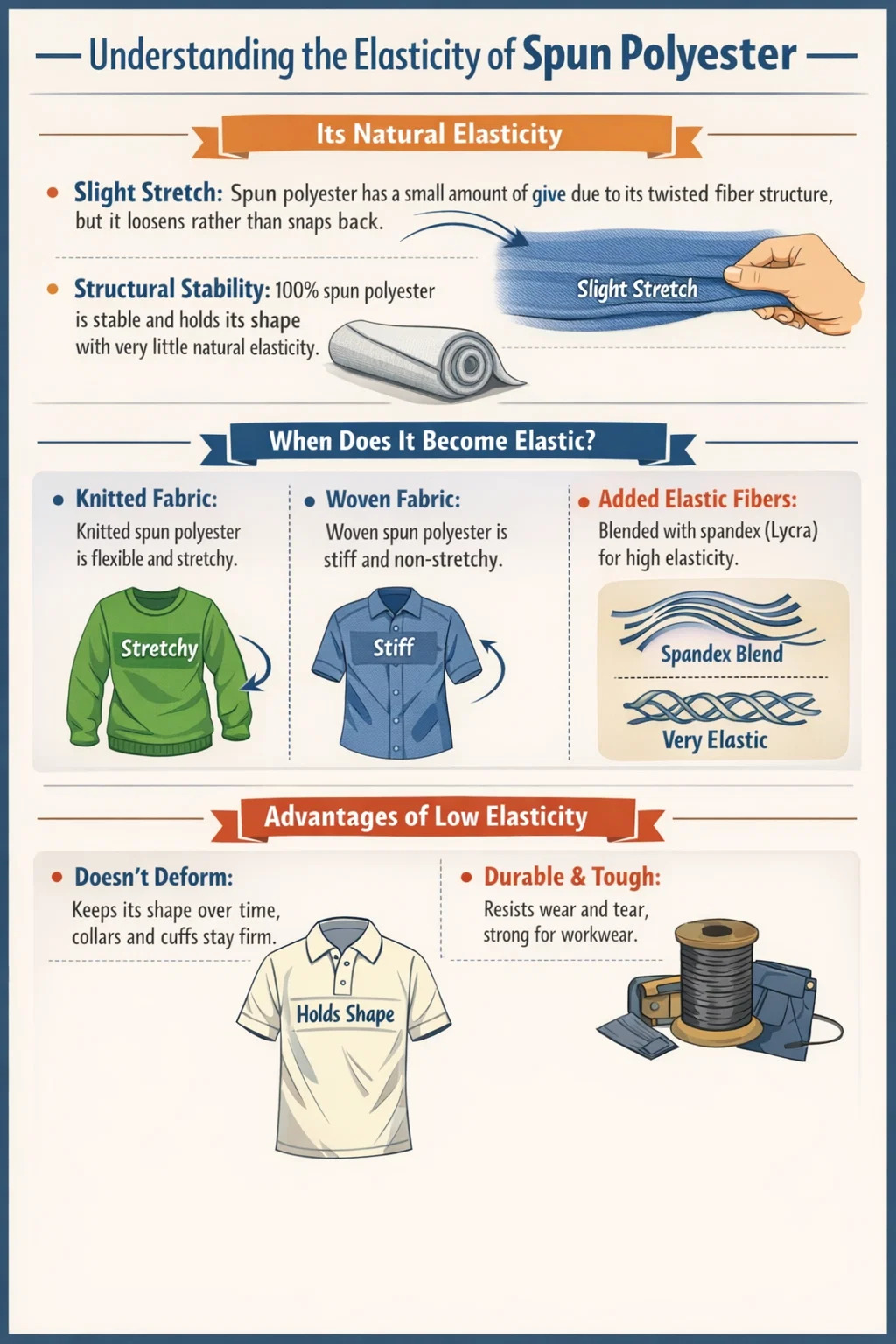
Slight stretch: Because spun polyester is made of countless short fibers twisted together into yarn, this twisted structure itself has a small amount of physical movement space. Therefore, when you pull it, it will give a little, but this feeling is more like the fabric loosening rather than rebounding like a rubber band.
Structural stability: Pure spun polyester is actually known for its stability. It's not like those loose clothes that stretch out after a few washes. Its main characteristic is maintaining its shape; if you buy 100% pure spun polyester, it basically has very little elasticity.
⇒ When does it become elastic?
The weaving method (knitted vs. woven):
If spun polyester is woven into a "knitted" structure like a sweatshirt, using the principle of loops interlocking, it becomes easier to wear and has some flexibility.
If it's woven into a "woven" structure like a tablecloth or shirt, it will feel stiff like paper and have almost no elasticity.
Addition of "elastic fibers": Often, manufacturers add a small amount of spandex (also known as Lycra) to spun polyester to make the clothing more comfortable. With just a little of this added, the fabric immediately becomes very elastic and will spring back no matter how much you stretch it.
⇒ The advantages of not having high elasticity
Doesn't deform with wear: Because spun polyester itself doesn't stretch much, the clothes made from it are very "obedient." Areas that tend to stretch, like collars and cuffs, will hold their shape for a long time and won't become baggy after a few washes.
Durable and hard-wearing: In areas that need to withstand stress (such as seams), non-elastic spun polyester is actually stronger. It won't thin or break due to repeated pulling, which is why many durable work clothes and napkins choose this material.
Quick Links
Products
Fill in your information here
